Ms. Cheese
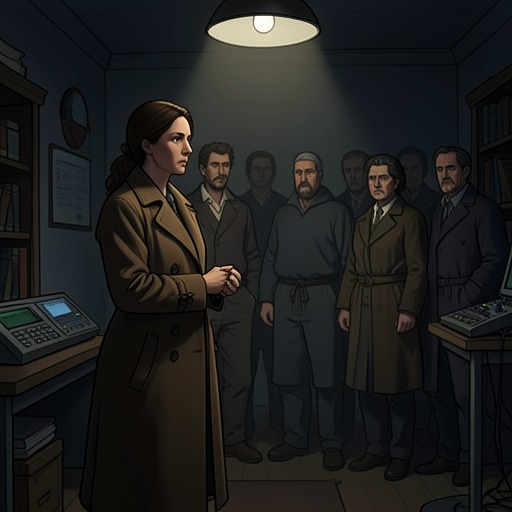
Made for LoveMs. Cheese, known to others as the Big Cheese, is the owner-manager of Ms. Cheese's Restaurant and Hazel's employer during a period of refuge and uncertainty. Her sharp manner and resemblance to Hazel's mother make the job an unexpected form of pretend intimacy: Hazel can accept a familiar kind of authority precisely because it belongs to someone at a safe distance. Ms. Cheese's bluntness does not erase her attention to Hazel; it gives their relationship its particular, rough-edged shape.
Identity and First Impressions
Hazel chooses the town where Jasper left her and seeks work at the diner partly because its owner is very mean and bossy and somewhat resembles her mother. The resemblance is not a substitute for reconciliation with her actual mother. Hazel feels able to manage the imitation, while imagining her mother herself returning to life makes working for her impossible. Ms. Cheese therefore occupies a deliberately limited place in Hazel's life: familiar enough to make the performance of closeness comforting, but distant enough not to demand the intimacy Hazel cannot bear.
Hazel asks to work out of public view, explaining that she has an anxiety disorder. Ms. Cheese warns her that the kitchen is hotter and pays less, but also explains that back-of-house staff can arrive without dressing for customers. She describes the less polished habits of the kitchen crew in practical, comic terms, making the job's conditions clear before Hazel accepts. When Hazel asks about paperwork, Ms. Cheese offers cash at a lower rate and frankly frames the arrangement as a business calculation. Hazel agrees, grateful that she will not have to lie on forms or invent a formal name. Though she privately considers names that would match her sense of failure, she panics when asked and gives her own: Hazel.
The nickname Big Cheese belongs to the staff, but Hazel tries to address her boss formally as Ms. Cheese, treating Cheese as a surname. The effort at politeness produces confusion in Ms. Cheese, a small mismatch that captures the difference between Hazel's guarded formality and the diner's unceremonious atmosphere. Their relationship develops through such awkward negotiations rather than through a conventional exchange of confidences.
Work, Humor, and Distance
The kitchen offers Hazel a kind of anonymity. Its orders move out to customers without requiring them to know who assembled them; the work matters, but its worker can remain unseen. Hazel likes the steam and repetition because they seem to help her forget. Mistakes, when they happen, bring Ms. Cheese back to correct her, usually by yelling. Even then, Ms. Cheese jokes that Hazel looks so downcast that customers would end up apologizing to her for complaining. The humor turns Hazel's visible dejection into an object of familiar observation, while also acknowledging how poorly suited she feels to public confrontation.
Ms. Cheese does not confine herself to managing orders. Once, after remarking that Hazel seems easily made uncomfortable, she takes the ice scoop from the machine, uses it to pack ice into her clothing, and leaves. The abrupt, matter-of-fact gesture is characteristic of the workplace's rough informality: Ms. Cheese can make an odd private need part of an ordinary shift, without turning it into a serious conversation. Hazel, meanwhile, is watching the small signs of disorder around her and thinking about how difficult it is to keep good and bad neatly separate.
Ms. Cheese also imagines Hazel as a possible match for her son, who lives in a nearby city and never visits. Hazel tries to end the matchmaking by inventing a series of reasons she would be unsuitable, including that she is barren, lesbian or asexual, and follows a religion the government considers a cult. Ms. Cheese does not take the list as a decisive objection; she thinks the two might still make a workable pair despite having little in common. The exchange shows Hazel using elaborate self-description as a barrier, while Ms. Cheese treats even that barrier with practical, unembarrassed optimism.
Blunt Care and Everyday Anecdotes
As Hazel moves slowly, Ms. Cheese sometimes scolds her, but she also recognizes the effort behind that slowness. She tells Hazel about dragging six children through a grocery store when they clung to her ankle, using the memory to describe how long it can take to move while carrying burdens. She then gives Hazel permission to take a break in the deep freezer before reminding her that the mayonnaise jars still need refilling for the dinner rush. The care is not detached from work: rest is offered alongside a concrete expectation and a deadline.
On other nights, Ms. Cheese gives Hazel a customer's barely drunk milkshake and asks her to drink it so she can see that Hazel is taking in calories. She insists that she has witnessed terrible tragedies but does not want to hear Hazel's story, which she believes would be too much for her. She calls Hazel loveless and haunted, and wonders aloud whether having her around brings bad luck. Hazel agrees that it probably does; Ms. Cheese responds by adding whipped cream to the glass. Her concern is material and immediate—food, a pause, a little more to drink—while her language remains unsentimental. She notices Hazel's distress without asking Hazel to make it into a narrative she is ready to tell.
Ms. Cheese's comic stories extend the same mixture of severity and eccentricity. She recounts firing a young employee who inhaled gas from whipped-cream cans, then repeats his explanation that he believed he was freeing the trapped souls of the dead. When he described the practice as service rather than a way to get high, Ms. Cheese answered that he should use his supposed heroism to wish for another job. The anecdote presents her as a manager willing to fire someone, but also as a teller who turns workplace misconduct into a compact joke rather than a solemn lesson.
Leaving, Returning, and Narrative Role
When Hazel says she has to leave town, Ms. Cheese says she is sorry to hear it. Her farewell is neither sentimental nor indifferent: she describes Hazel as not especially bright or industrious, admits that she will miss the sight of her sulking face, and says that it reminds her of what she has to be thankful for. She offers the cash Hazel has earned that week, adjusted because the notice is short, and asks whether Hazel needs any resources or would like a large bag of rice. Hazel accepts both. Her thoughts turn the rice into imagined protection and a possible trail to follow, but she also recognizes that no one would be looking for her. Ms. Cheese's practical offer cannot undo that isolation; it does give Hazel provisions as she prepares to go.
The apparent departure does not hold. The next morning Hazel returns to the diner and puts on the apron she left there. Ms. Cheese recognizes her by the quiet way she shuts the door and walks, jokes that Hazel must be back to work for food, then assigns her to scrub the heating coils during the fryer clean-out. The exchange makes the return ordinary rather than ceremonial: Ms. Cheese neither demands an explanation nor treats Hazel's reappearance as a fresh beginning. Later that day, Hazel tells a cook that news she heard the previous day has left her trembling, using the comparison of prolonged tickling turning painful to describe her agitation. The scene places her renewed work routine beside a panic she cannot simply work away.
Ms. Cheese's narrative importance lies in this balance of distance and involvement. She does not become Hazel's confidante, and she explicitly declines to hear the story behind Hazel's haunted appearance. Yet she watches her, feeds her, offers a break, considers her future, and gives her cash and food when she says she must leave. The diner makes a provisional shelter through routine and practical exchanges rather than through disclosure. Ms. Cheese's care remains bossy, comic, and bounded, but its limits are part of why Hazel can accept it.